youssef_itani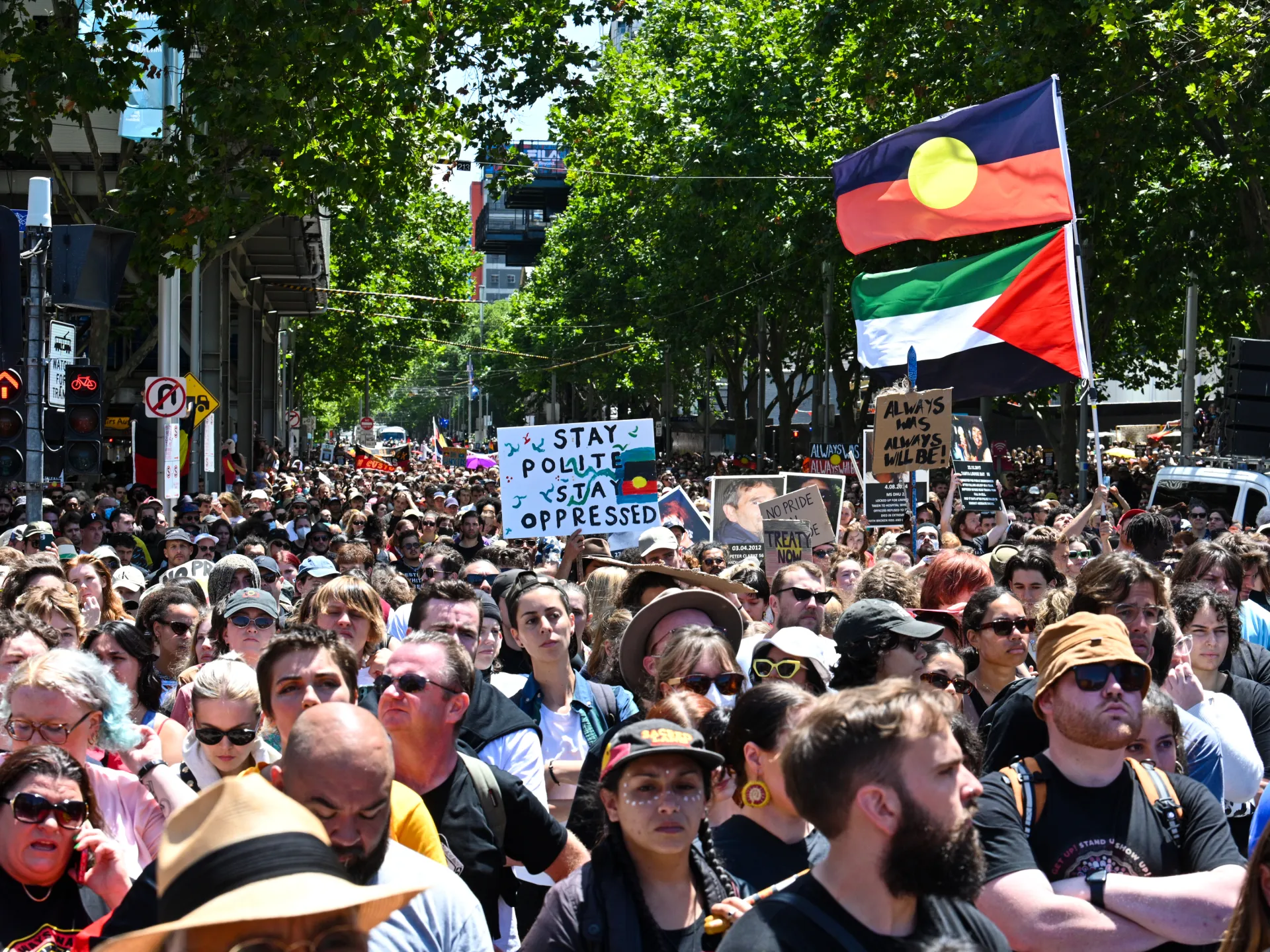
The treaty, which comes more than 220 years after the state was colonised, creates an assembly and truth-telling body.

Published On 13 Nov 2025
The first treaty between Indigenous people and a government in Australia has entered into law in the state of Victoria after it was finalised and signed.
Members of the state’s First Peoples Assembly gathered for a ceremony to sign the document on Wednesday evening before state Governor Margaret Gardner added her signature to the treaty on Thursday morning.
Recommended Stories
list of 4 itemsend of list
Jill Gallagher, a Gunditjmara woman and former commissioner of the Victorian Treaty Advancement Commission, told Australian public broadcaster ABC that the treaty represents “the story of the Aboriginal people’s resistance”.
“I feel very happy. I’m just over the moon,” Gallagher said.
“Today marks a turning point in our nation’s history, a moment where old wounds can begin to heal and new relationships can be built on truth, justice and mutual respect,” she said.
Victoria’s Premier Jacinta Allan described the signing of the treaty as marking a “new chapter” in the state’s history.
“It is a chapter that is founded on truth, guided by respect and carried forward through partnership … a partnership to build a stronger, fairer, more equal Victoria for everyone,” Allan said.
Australia was colonised by the then-British Empire in 1788, with settlers first arriving in what is now known as Victoria in the early 1800s.
While British powers entered into treaties with Indigenous peoples in other colonised countries, including Canada, New Zealand and the United States, no treaty was ever signed in Australia.
The treaty, which has been described as historic by the United Nations human rights chief Volker Turk, formalises the creation of the permanent First Peoples’ Assembly of Victoria.
Turk said the treaty “addresses the continued exclusion of and discrimination against the country’s First Peoples – the result of colonisation”.
The agreement, he added, had the “potential to be truly transformative, ensuring the First Peoples have a direct voice in advising and shaping laws, policies and practices that affect their lives”.
The treaty process began in 2016 and included the Yoorrook Justice Commission, a formal truth-telling body which concluded in June this year and heard from Indigenous people harmed by colonisation, including members of the Stolen Generations, who were Indigenous children taken from their families and communities by state agencies and religious organisations.
Australia held a referendum in 2023 that sought to change the constitution and create a permanent Indigenous voice to inform parliament on issues related to Indigenous people.
The referendum failed to achieve enough support to change the constitution.
The referendum followed after the 2017 Uluru Statement from the Heart petition, which had called for an Indigenous voice to inform parliament, and emphasised that Indigenous people had 60,000 years of ancestral ties to their land. This “sacred link” could not be erased from world history in “merely” 200 years, according to the statement.